
1997 Centenary of Pigeon Post
«previous next»
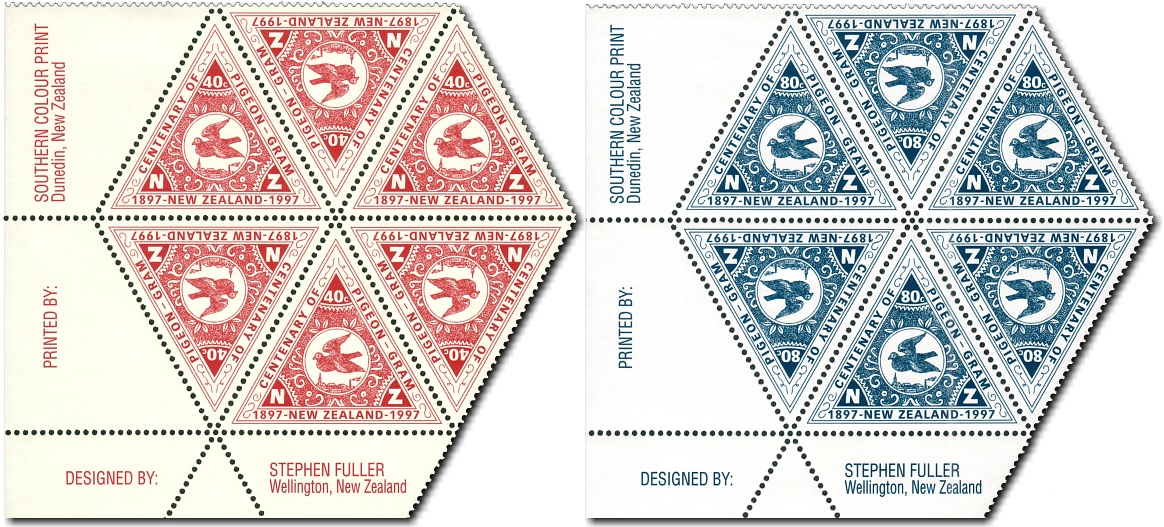
| Cat. | Mint Unhinged | Fine Used | ||||
| 40c | Centenary of the Pigeongram - Carmine Red (1 shilling) | 444a | $1.15 | $1.05 | ||
| 80c | Centenary of the Pigeongram - Blue Grey (6 pence) | 444b | $2.25 | $2.25 | ||
| Set of 2 | 444c | $3.25 | $3.15 | |||
| Se-tenant Pair of two 40 cent stamps - tête-bêche (upright / inverted) | 444d | $2.25 | $2.15 | |||
| … Two Stamps : 40c (444a x 2) | ||||||
| Se-tenant Pair of two 80 cent stamps - tête-bêche (upright / inverted) | 444e | $4.50 | $4.25 | |||
| … Two Stamps : 80c (444b x 2) | ||||||
| First Day Cover - 7 May 1997 | 444f | $4.25 | ||||
| … Two Stamps : 40c (444a), 80c (444b) | ||||||
'The Great Barrier Pigeongram Agency' issued their own distinctive triangular stamps in 1899 charging 6d from Great Barrier Island to Tāmaki Makaurau / Auckland and 1/- from Auckland back to the Island. The return trip cost twice the price because of the difficulty training birds to return to the island. The triangular stamps which are reproduced in this issue were designed by Māori war veteran H. C. Wrigg (who won the coveted New Zealand Cross for bravery) and were printed by The Auckland Star.
Messages were written on very lightweight paper so as not to weigh the poor birds down on their flight and a stamp was attached. On arrival in Tāmaki Makaurau / Auckland, the message would either be delivered in person or posted via the Post Office if the recipient lived further away. In one case, a medical emergency on Aotea / Great Barrier Island involving an acute case of appendicitis was remedied by a pigeongram calling for the weekly boat to come early to ferry the afflicted individual to Auckland Hospital - thereby almost certainly saving their life.
The service was later extended to Marotiri Island but was discontinued when an underwater telegraph cable was laid in 1907.
Bibliography
The Postage Stamps of New Zealand Volume X
Edited by B.G. Vincent FRPSNZ
Published 2013 by The Royal Philatelic Society of New Zealand Incorporated (ISBN 978-0-9876534-3-7)
Pages 67 - 68, 747 - 761
Catalogue ·
1996 ·
1997 ·
1998 ·
Commemoratives
Order Form · Currency Converter · Privacy Policy
What to Expect · Contact Us · Links
Order Form · Currency Converter · Privacy Policy
What to Expect · Contact Us · Links
This page was last updated on 17 Oct 2026
All content and images copyright © 2008 - 2026 StampsNZ
All content and images copyright © 2008 - 2026 StampsNZ