
1935 Pictorials
«previous next»
| Cat. | Mint Unhinged | Mint Hinged | Fine Used | |||||
| ½d | Fantail (Simplified) | 50a | $2.15 | $1.10 | $0.90 | |||
| (i) with single watermark and vertical mesh) | 50a1 | $2.25 | $1.30 | $1.10 | ||||
| (ii) with multiple watermark and horizontal mesh) | 50a2 | $2.25 | $1.35 | $1.10 | ||||
| 1d | Kiwi (Simplified) | 50b | $2.25 | $1.15 | $0.70 | |||
| (i) with single watermark and vertical mesh) / Die I / Perf 14x13½ | 50b1 | $2.70 | $1.35 | $1.35 | ||||
| (ii) with single watermark and vertical mesh) / Die I / Temporary perf 13½x14 | 50b2 | $270.00 | $135.00 | $81.00 | ||||
| (iii) with single watermark and vertical mesh) / Die II / Perf 14x13½ | 50b3 | $22.50 | $9.00 | $4.50 | ||||
| (iv) with multiple watermark and horizontal mesh) / Die III / Perf 14x13½ | 50b4 | $2.70 | $1.80 | $0.90 | ||||
| 1½d | Maori Cooking (Simplified) | 50c | $9.00 | $4.50 | $3.60 | |||
| (i) with single watermark and vertical mesh) / Perf 14x13½ | 50c1 | $12.75 | $5.40 | $16.20 | ||||
| (ii) with single watermark and vertical mesh) / Perf 13½x14 / Printed on wet paper | 50c2 | $10.80 | $5.40 | $10.80 | ||||
| (iii) with single inverted and reversed watermark and vertical mesh) / Perf 13½x14 / Printed on wet paper | 50c3 | $90.00 | $36.00 | $45.00 | ||||
| (iv) with multiple watermark and horizontal mesh) / Perf 14x13½ | 50c4 | $9.00 | $5.40 | $4.50 | ||||
| 2d | Whare (Simplified) | 50d | $1.80 | $0.80 | $1.55 | |||
| (i) with single watermark and vertical mesh) / Perf 14x13½ | 50d1 | $6.80 | $3.60 | $2.25 | ||||
| (ii) with multiple watermark and horizontal mesh) / Perf 14x13½ | 50d2 | $2.35 | $0.90 | $1.80 | ||||
| (iii) with multiple watermark and horizontal mesh) / De la Rue Perf 14 Line | 50d3 | $36.00 | $18.00 | $18.00 | ||||
| (iv) with multiple watermark and horizontal mesh) / Harrison Perf 14x15 Line | 50d4 | $63.00 | $31.50 | $31.50 | ||||
| (v) with multiple watermark and horizontal mesh) / Waterlow Perf 12½ Line | 50d5 | $4.50 | $3.15 | $1.80 | ||||
| (vi) with multiple watermark and horizontal mesh) on coarse paper / Perf 14x13½ | 50d6 | $2.25 | $0.90 | $1.80 | ||||
| 2½d | Mount Cook (Simplified) | 50e | $4.50 | $2.25 | $3.60 | |||
| (i) with single watermark and vertical mesh) / Perf (14+13)x13½ | 50e1 | $20.25 | $10.80 | $28.80 | ||||
| (ii) with single watermark and vertical mesh) / Perf 13½x14 / Printed on wet paper | 50e2 | $20.25 | $10.80 | $25.20 | ||||
| (iii) with multiple watermark and horizontal mesh) / Perf (14+13)x13½ | 50e3 | $20.25 | $10.80 | $19.80 | ||||
| (iv) with multiple watermark and horizontal mesh) / Perf 14 Line | 50e4 | $10.80 | $5.40 | $4.50 | ||||
| (v) with multiple watermark and horizontal mesh) / Perf 14 Comb | 50e5 | $10.80 | $5.40 | $10.80 | ||||
| (vi) with multiple watermark and horizontal mesh) / Perf 13¾x13½ / Coarse paper | 50e6 | $5.40 | $2.70 | $10.80 | ||||
| (vii) with multiple watermark and horizontal mesh) / Perf 14¼x13½ / Coarse paper | 50e7 | $5.40 | $2.70 | $19.80 | ||||
| 3d | Wahine (Simplified) | 50f | $72.00 | $34.20 | $1.80 | |||
| (i) with single watermark and vertical mesh) | 50f1 | $73.80 | $37.80 | $2.25 | ||||
| (ii) with multiple watermark and horizontal mesh) | 50f2 | $73.80 | $37.80 | $2.25 | ||||
| 4d | Mitre Peak (Simplified) | 50g | $9.00 | $4.50 | $1.10 | |||
| (i) with single watermark and vertical mesh) / Perf 14 Comb | 50g1 | $28.80 | $14.40 | $5.40 | ||||
| (ii) with multiple watermark and horizontal mesh) / Perf 14x13½ | 50g2 | $10.80 | $5.40 | $1.35 | ||||
| (iii) with multiple watermark and horizontal mesh) / Waterlow Perf 12½ Line | 50g3 | $37.80 | $19.80 | $19.80 | ||||
| (iv) with multiple watermark and horizontal mesh) / De La Rue Perf 14 Line | 50g4 | $234.00 | $117.00 | $234.00 | ||||
| (v) with multiple watermark and horizontal mesh) / Perf 14x14½ / Coarse paper | 50g5 | $10.80 | $5.40 | $1.35 | ||||
| 5d | Swordfish (Simplified) | 50h | $9.00 | $4.50 | $1.35 | |||
| (i) with single watermark and vertical mesh) / Perf (13+14)x13½ | 50h1 | $139.50 | $55.80 | $37.80 | ||||
| (ii) with single watermark and vertical mesh) / Perf 13½x14 | 50h2 | $189.00 | $99.00 | $46.80 | ||||
| (iii) with multiple watermark and horizontal mesh) / Perf (13+14) or (14+13)x13½ | 50h3 | $37.80 | $19.80 | $4.50 | ||||
| (iv) with multiple watermark and horizontal mesh) / Perf 12½ / Fine paper | 50h4 | $99.00 | $46.80 | $20.25 | ||||
| (v) with multiple watermark and horizontal mesh) / Perf 12½ / Coarse paper | 50h5 | $99.00 | $46.80 | $10.80 | ||||
| (vi) with multiple watermark and horizontal mesh) / Perf 13¾x13½ / Coarse paper | 50h6 | $9.90 | $5.40 | $1.80 | ||||
| 6d | Harvesting (Simplified) | 50i | $6.30 | $3.15 | $1.60 | |||
| (i) with single watermark and vertical mesh) / Perf 13½x14 | 50i1 | $46.80 | $23.40 | $9.00 | ||||
| (ii) with multiple watermark and horizontal mesh) / Perf 13½x14 | 50i2 | $37.80 | $18.90 | $1.80 | ||||
| (iii) with multiple watermark and horizontal mesh) / Waterlow Perf 12½ | 50i3 | $8.10 | $3.60 | $3.60 | ||||
| (iv) with multiple watermark and horizontal mesh) / De La Rue Perf 14½x14 / Fine paper | 50i4 | $55.80 | $28.80 | $1.80 | ||||
| (v) with multiple watermark and horizontal mesh) / Perf 14½x14 / Coarse paper | 50i5 | $8.10 | $3.60 | $1.80 | ||||
| 8d | Tuatara (Simplified) | 50j | $9.00 | $4.50 | $1.80 | |||
| (i) with single sideways watermark and horizontal mesh) / Perf 14x13½ | 50j1 | $37.80 | $19.80 | $19.80 | ||||
| (ii) with multiple sideway watermark and vertical mesh) / Perf 14x13½ | 50j2 | $28.80 | $14.40 | $2.25 | ||||
| (iii) with multiple upright watermark and horizontal mesh) / Perf 14x13½ | 50j3 | $9.90 | $5.40 | $2.25 | ||||
| (iv) with multiple sideway watermark and vertical mesh) / Perf 12½ | 50j4 | $9.90 | $5.40 | $2.25 | ||||
| (v) with multiple sideway watermark and vertical mesh) / Perf 14x14½ / Coarse paper | 50j5 | $9.90 | $5.40 | $2.25 | ||||
| 9d | Larger 18 x 21½mm Design (1936 - 1938 Printings) / Variable shades of Scarlet, Bright or Dull Red / Slate Grey to Black (Simplified) | 50k | $90.00 | $45.00 | $5.40 | |||
| (i) with single watermark and vertical mesh) / Perf 14x14½ / Scarlet and dull black | 50k1 | $99.00 | $46.80 | $6.30 | ||||
| (ii) with multiple sideways watermark and horizontal mesh) / Perf 14x15 / Various shades | 50k2 | $93.50 | $46.80 | $6.30 | ||||
| (iii) with multiple upright watermark and horizontal mesh) / Perf 14x14½ / Various shades | 50k3 | $99.00 | $46.80 | $6.30 | ||||
| 9d | Smaller 17½ x 20½ mm Design (from 1941 on) / Consistently Scarlet / Jet Black (Simplified) | 50l | $9.00 | $5.40 | $4.50 | |||
| (i) with single watermark and vertical mesh) / Perf 14x15 | 50l1 | $247.50 | $126.00 | $49.50 | ||||
| (ii) with multiple watermark and vertical mesh) / Perf 14x15 | 50l2 | $9.90 | $6.30 | $5.40 | ||||
| 1/- | Tui (Simplified) | 50m | $10.80 | $5.40 | $1.35 | |||
| (i) with single watermark and vertical mesh) / Perf 14x13½ | 50m1 | $90.00 | $45.00 | $19.80 | ||||
| (ii) with multiple watermark and horizontal mesh) / Perf 14x13½ | 50m2 | $11.70 | $6.30 | $1.80 | ||||
| (iii) with multiple watermark and horizontal mesh) / Waterlow Perf 12½ | 50m3 | $139.50 | $67.50 | $30.60 | ||||
| (iv) with multiple watermark and horizontal mesh) / Perf 14x13½ / Coarse paper | 50m4 | $11.70 | $6.30 | $1.80 | ||||
| 2/- | Captain Cook (Simplified) | 50n | $18.00 | $9.00 | $1.80 | |||
| (i) with single watermark and vertical mesh) / Perf (13+14)x13½ | 50n1 | $198.00 | $99.00 | $48.60 | ||||
| (ii) with single watermark and vertical mesh) / Perf 13½x14 | 50n2 | $198.00 | $99.00 | $48.60 | ||||
| (iii) with multiple watermark and horizontal mesh) / Perf (13+14)x13½ | 50n3 | $76.50 | $39.60 | $5.40 | ||||
| (iv) with multiple watermark and horizontal mesh) / Perf 13½x14 | 50n4 | $594.00 | $297.00 | $8.10 | ||||
| (v) with multiple watermark and horizontal mesh) / Waterlow Perf 12½ / Fine paper | 50n5 | $144.00 | $72.00 | $9.90 | ||||
| (vi) with multiple watermark and horizontal mesh) / Waterlow Perf 12½ / Coarse paper | 50n6 | $43.20 | $21.60 | $5.40 | ||||
| (vii) with multiple watermark and horizontal mesh) / Perf 13¾x13½ / Coarse paper | 50n7 | $19.80 | $9.90 | $2.15 | ||||
| 3/- | Mount Egmont (Simplified) | 50o | $27.00 | $13.50 | $6.75 | |||
| (i) with single watermark and vertical mesh) / Perf (14+13)x13½ | 50o1 | $171.00 | $79.20 | $52.20 | ||||
| (ii) with single watermark and vertical mesh) / Perf 13½x14 / Printed on wet paper | 50o2 | $144.00 | $75.60 | $52.20 | ||||
| (iii) with single inverted and reversed watermark and vertical mesh) / Perf 13½x14 / Printed on wet paper | 50o3 | $1,530.00 | $738.00 | $495.00 | ||||
| (iv) with multiple watermark and horizontal mesh) / Perf (14+13)x13½ | 50o4 | $99.00 | $49.50 | $8.10 | ||||
| (v) with multiple watermark and horizontal mesh) / Waterlow Perf 12½ | 50o5 | $153.00 | $73.80 | $67.50 | ||||
| (vi) with multiple watermark and horizontal mesh) / Perf 13¾x13½ / Coarse paper | 50o6 | $40.50 | $19.80 | $10.80 | ||||
| (vii) with multiple watermark and horizontal mesh) / Perf 14¼x13½ / Coarse paper | 50o7 | $30.60 | $15.30 | $7.20 | ||||
| Set of 15 | 50p | $265.80 | $132.00 | $35.90 | ||||
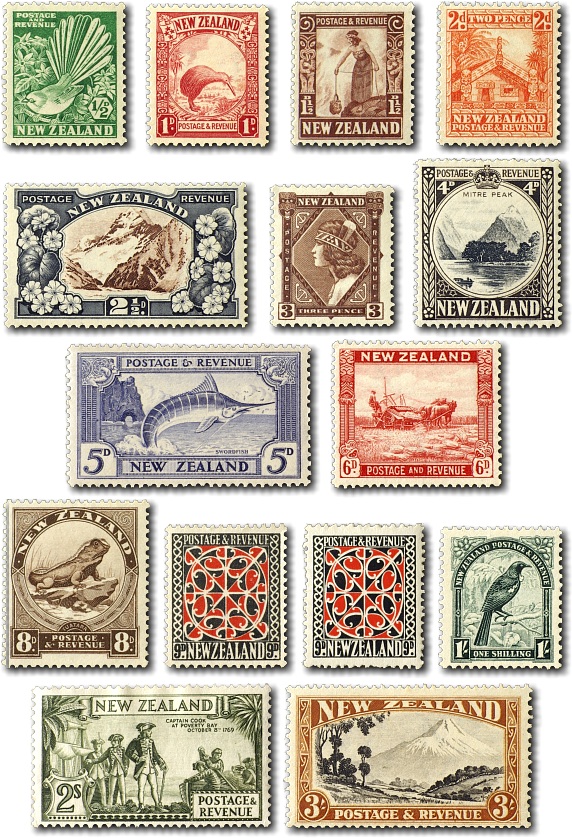
Entries were divided into New Zealand subject groups: fauna, scenery, Maori art, agricultural, history and sport. Over 1,500 entries were received and designs from eleven contributors were included in the final set.
The stamps suffered a series of delays though - printing by photogravure was abandoned in favour of line etching with the exception of the nine penny stamp which was the first New Zealand stamp printed by offset lithography. There were also issues with paper quality and the shilling stamp design was changed before issue.
The halfpenny stamp features the Fantail (Piwakawaka) with native Clematis in the background. The fantail is a very sociable New Zealand native bird which darts around eating insects.
The penny stamp features the Kiwi - several species of flightless birds endemic to New Zealand. The kiwi is also a national symbol of New Zealand.
The 1½d stamp features a Maori woman cooking food by lowering it in a flax basket or kete into a boiling geothermal spring.
The twopence stamp features a traditional Maori Meeting House.
The 2½d stamp is two-tone with Mount Cook (Aorangi) in the centre bordered on both sides by the Mount Cook Buttercup (Ranunculus lyallii) - a species of buttercup endemic to the South Island of New Zealand at altitudes of 700 to 1,500 metres.
The threepence stamp features a Maori girl (Wahine) wearing an intricately woven flax head-band (pare). A Huia feather is in her hair - a mark of great prestige.
The four penny stamp features a view of Mitre Peak in Milford Sound.
The 5d stamp features a Striped Marlin or Swordfish with Piercy Island ("The Hole In The Rock"), a famous fishing ground for swordfish on the left.
The sixpence stamp features a horse drawn harvester or reaper, working through a crop of wheat.
The eight penny stamp features the native Tuatara - the only surviving member of the Sphenodontians which flourished around 200 million years ago. The name "tuatara" derives from the Maori language meaning "peaks on the back".
The 9d stamp features the ornamentation from a Maori sliding door panel. This stamp was printed using offset lithography rather than recess printed like the rest of the stamps in the issue. The stamp was issued in two main forms. The initial prints from plates first prepared by Waterlow and Sons and subsequently by Coulls Somerville Wilkie with the stamp design measuring 18 by 21½ mm are quite variable in colour from dull red, bright red and brick red with the frame in dull grey, slate grey or black. Later printings from new plates from Coulls Somerville Wilkie have a smaller design measuring 17½ by 20½ mm (with a subsequently larger white border) and are consistently scarlet against a shiny black frame. The stamps are best distinguished by the size of the design as not all of the initial larger design printings have a grey border.
The shilling stamp features the Tui - a very intelligent bird much like parrots. They are able to clearly imitate human speech. The possession of two voiceboxes enable Tui to perform a myriad of vocalisations.
The two shilling stamp shows the landing of Captain Cook at Poverty Bay on the 8th of October 1769. The first encounter with local Maori led to the deaths of six Maori during skirmishes with the crew due to a misinterpretation of the traditional Maori challenge. Cook was unable to gain many of the provisions he and his crew needed at the bay, and for this reason gave it its name.
The three shilling stamp shows a pastoral view with Mount Egmont / Mount Taranaki in the background. Mount Taranaki is a dormant stratovolcano on the west coast of the North Island. It is geologically young - volcanic activity commenced around 135,000 years ago.
Bibliography
The Postage Stamps of New Zealand (Volume I)
Edited by R. J. G. Collins and H. T. M. Fathers B.A. B.Sc.
Published 1938 by The Philatelic Society of New Zealand Incorporated
Pages 338 - 369, 581 - 582
The Postage Stamps of New Zealand Volume II
Edited by R. J. G. Collins FRPSNZ and C. W. Watts FRPSNZ
Published 1950 by The Royal Philatelic Society of New Zealand Incorporated
Pages 1 - 54
The Postage Stamps of New Zealand Volume IV
Edited by R. J. G. Collins FRPSNZ and C.W. Watts FRPSNZ
Published 1960 by The Royal Philatelic Society of New Zealand Incorporated
Pages 380 - 383
The Postage Stamps of New Zealand Volume VI
Edited by D. E. G. Naish FRPSNZ and K. J. McNaught FRPSNZ FRPSL
Publsihed 1975 by The Royal Philatelic Society of New Zealand Incorporated
Pages 26 - 33, 360
The Postage Stamps of New Zealand Volume VIII
Edited by B. G. Vincent FRPSNZ
Published 1998 by The Royal Philatelic Society of New Zealand Incorporated (ISSN 0-9597883-1-X)
Pages 712, 749, 750
Catalogue ·
1934 ·
1935 ·
1936 ·
Definitives
Order Form · Currency Converter · Privacy Policy
What to Expect · Contact Us · Links
Order Form · Currency Converter · Privacy Policy
What to Expect · Contact Us · Links
This page was last updated on 23 Jul 2026
All content and images copyright © 2008 - 2026 StampsNZ
All content and images copyright © 2008 - 2026 StampsNZ