
1935 Pictorials Official
«previous next»
| Cat. | Mint Unhinged | Mint Hinged | Fine Used | |||||
| ½d | Fantail | 54a | $9.00 | $5.40 | $4.95 | |||
| 1d | Kiwi (Simplified) | 54b | $11.70 | $5.85 | $0.90 | |||
| (i) Single Watermark Perf 14 x 13½ | 54b1 | $12.60 | $5.85 | $1.10 | ||||
| (ii) Single Watermark Perf 13½ x 14 | 54b2 | $405.00 | $198.00 | $100.80 | ||||
| (iii) Multiple Watermark | 54b3 | $12.60 | $6.30 | $1.10 | ||||
| 1½d | Maori Cooking (Simplified) | 54c | $18.00 | $9.00 | $7.20 | |||
| (i) Single Watermark | 54c1 | $40.50 | $21.60 | $40.50 | ||||
| (ii) Multiple Watermark | 54c2 | $19.80 | $10.80 | $8.10 | ||||
| 2d | Whare (Simplified) | 54d | $5.40 | $2.55 | $1.45 | |||
| (i) Perf 14 x 13½ Fine | 54d1 | $6.30 | $3.60 | $1.60 | ||||
| (ii) Perf 14 Line | 54d2 | $100.80 | $49.50 | $31.50 | ||||
| (iii) Perf 12½ | 54d3 | $247.50 | $117.00 | $99.00 | ||||
| (iv) Perf 14 x 13½ Coarse | 54d4 | $7.20 | $3.15 | $1.60 | ||||
| 2½d | Mount Cook (Simplified) | 54e | $27.00 | $13.50 | $22.50 | |||
| (i) Perf 14 - 13 x 13½ | 54e1 | $76.50 | $36.00 | $76.50 | ||||
| (ii) Perf 14 Line | 54e2 | $28.80 | $15.30 | $25.20 | ||||
| (iii) Perf 14 Comb | 54e3 | $28.80 | $15.30 | $25.20 | ||||
| 3d | Wahine | 54f | $126.00 | $59.40 | $4.95 | |||
| 4d | Mitre Peak (Simplified) | 54g | $22.50 | $10.80 | $1.35 | |||
| (i) Perf 14 x 13½ | 54g1 | $24.30 | $11.70 | $1.55 | ||||
| (ii) Perf 14 Line | 54g2 | $24.30 | $11.70 | $5.40 | ||||
| (iii) Perf 12½ | 54g3 | $24.30 | $11.70 | $5.40 | ||||
| (iv) Perf 14 x 14½ | 54g4 | $23.40 | $11.70 | $1.55 | ||||
| 6d | Harvesting (Simplified) | 54h | $27.00 | $12.75 | $2.70 | |||
| (i) Perf 13½ x 14 | 54h1 | $30.60 | $14.40 | $3.15 | ||||
| (ii) Perf 12½ | 54h2 | $30.60 | $14.40 | $5.40 | ||||
| (iii) Perf 14½ x 14 Fine | 54h3 | $99.00 | $50.40 | $3.15 | ||||
| (iv) Perf 14½ x 14 Coarse | 54h4 | $30.60 | $14.40 | $3.15 | ||||
| 8d | Tuatara (Simplified) | 54i | $40.50 | $19.80 | $9.00 | |||
| (i) Perf 12½ | 54i1 | $45.00 | $21.60 | $10.80 | ||||
| (ii) Perf 14 x 14½ | 54i2 | $45.00 | $21.60 | $10.80 | ||||
| 9d | Larger 18 x 21½mm Design (1938 Printing) / Red / Slate Grey / Overprinted Green | 54j | $450.00 | $153.00 | $49.50 | |||
| 9d | Smaller 17½ x 20½ mm Design (1943 printing) / Scarlet / Jet Black / Overprinted Black | 54k | $118.80 | $50.40 | $45.00 | |||
| 1/- | Tui (Simplified) | 54l | $45.00 | $22.50 | $3.60 | |||
| (i) Single Watermark | 54l1 | $130.50 | $64.80 | $76.50 | ||||
| (ii) Multiple Watermark Perf 14 x 13½ Fine | 54l2 | $76.50 | $36.00 | $4.50 | ||||
| (iii) Multiple Watermark Perf 12½ | 54l3 | $49.50 | $25.20 | $4.50 | ||||
| (iv) Multiple Watermark Perf 14 x 13½ Coarse | 54l4 | $90.00 | $45.00 | $4.50 | ||||
| 2/- | Captain Cook (Simplified) | 54m | $135.00 | $67.50 | $13.50 | |||
| (i) Perf 13 - 14 x 13½ | 54m1 | $166.50 | $85.50 | $49.50 | ||||
| (ii) Perf 13½ x 14 | 54m2 | $652.50 | $315.00 | $10.80 | ||||
| (iii) Perf 12½ Fine | 54m3 | $252.00 | $126.00 | $22.50 | ||||
| (iv) Perf 12½ Coarse | 54m4 | $153.00 | $76.50 | $15.30 | ||||
| (v) Perf 13¾ x 13½ | 54m5 | $148.50 | $76.50 | $15.30 | ||||
| Set of 13 | 54n | $984.10 | $410.85 | $158.25 | ||||
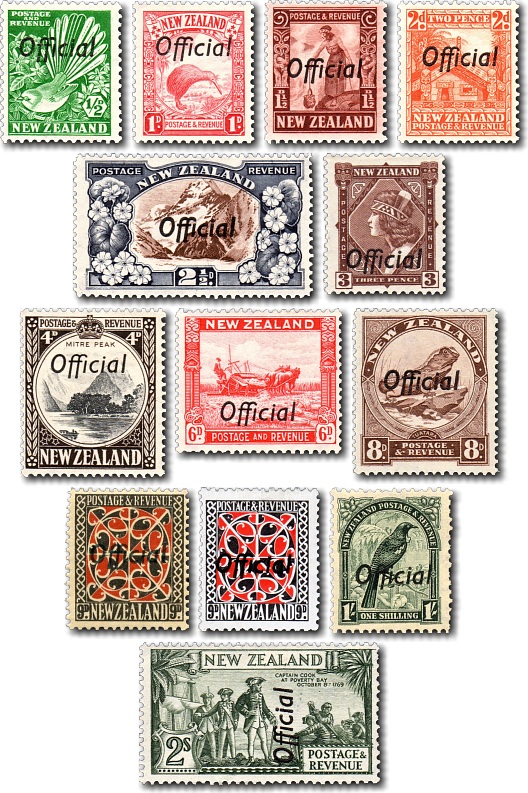
The halfpenny stamp features the Fantail (Piwakawaka) with native Clematis in the background. The fantail is a very sociable New Zealand native bird which darts around eating insects.
The penny stamp features the Kiwi - several species of flightless birds endemic to New Zealand. The kiwi is also a national symbol of New Zealand.
The 1½d stamp features a Maori woman cooking food by lowering it in a flax basket or kete into a boiling geothermal spring.
The twopence stamp features a traditional Maori Meeting House.
The 2½d stamp is two-tone with Mount Cook (Aorangi) in the centre bordered on both sides by the Mount Cook Buttercup (Ranunculus lyallii) - a species of buttercup endemic to the South Island of New Zealand at altitudes of 700 to 1,500 metres.
The threepence stamp features a Maori girl (Wahine) wearing an intricately woven flax head-band (pare). A Huia feather is in her hair - a mark of great prestige.
The four penny stamp features a view of Mitre Peak in Milford Sound.
The sixpence stamp features a horse drawn harvester or reaper, working through a crop of wheat.
The eight penny stamp features the native Tuatara - the only surviving member of the Sphenodontians which flourished around 200 million years ago. The name "tuatara" derives from the Maori language meaning "peaks on the back".
The 9d stamp features the ornamentation from a Maori sliding door panel. This stamp was printed using offset lithography rather than recess printed like the rest of the stamps in the issue. The stamp was issued in two forms. The initial green overprints on the red and grey 1938 printing measure 18 by 21½ mm. The 1941 black overprinting on the scarlet and black stamps had a slightly smaller design - 17½ by 20½ mm.
The shilling stamp features the Tui - a very intelligent bird much like parrots. They are able to clearly imitate human speech. The possession of two voiceboxes enable Tui to perform a myriad of vocalisations.
The two shilling stamp shows the landing of Captain Cook at Poverty Bay on the 8th of October 1769. The first encounter with local Maori led to the deaths of six Maori during skirmishes with the crew due to a misinterpretation of the traditional Maori challenge. Cook was unable to gain many of the provisions he and his crew needed at the bay, and for this reason gave it its name.
Bibliography
The Postage Stamps of New Zealand (Volume I)
Edited by R. J. G. Collins and H. T. M. Fathers B.A. B.Sc.
Published 1938 by The Philatelic Society of New Zealand Incorporated
Pages 469 - 471
The Postage Stamps of New Zealand Volume II
Edited by R. J. G. Collins FRPSNZ and C. W. Watts FRPSNZ
Published 1950 by The Royal Philatelic Society of New Zealand Incorporated
Pages 177 - 181, 184 - 185
Catalogue ·
1934 ·
1935 ·
1936 ·
Definitives ·
Official
Order Form · Currency Converter · Privacy Policy
What to Expect · Contact Us · Links
Order Form · Currency Converter · Privacy Policy
What to Expect · Contact Us · Links
This page was last updated on 16 May 2026
All content and images copyright © 2008 - 2026 StampsNZ
All content and images copyright © 2008 - 2026 StampsNZ